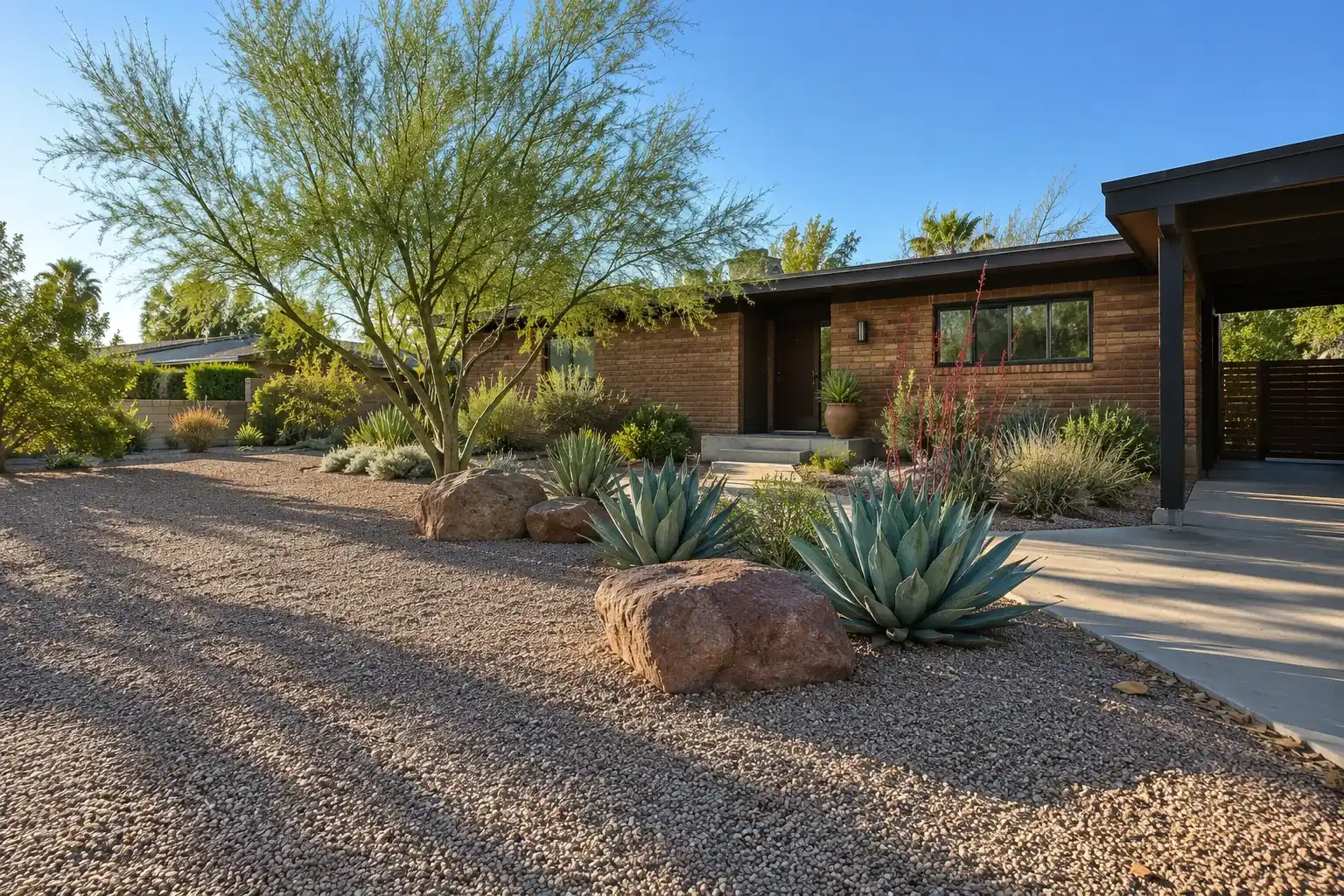
Desert front yard of a brick ranch house with gravel, boulders, agaves and a palo verde tree in morning light

Phoenix, Arizona

Landscaping in Phoenix, AZ

Want a yard that survives July? Tell us what you picture. Someone from our team will call you back to plan it.

Last updated

Landscaping in Phoenix is a water and soil problem before it is a planting problem, and the published ranges for the work run from $1,248 to $6,068 for most projects. This page covers what each service costs, what the work involves, and what a written scope should include.

055 services

Which services are available in Phoenix?

There are 5 services across the Phoenix area, and many yards need 2 or 3 of them in the same project.

The order matters as much as the list. Water and grade come first, then hardscape, then planting and turf, because moving a line after a patio is set costs far more than running it before. A repair can be 1 visit, while a full yard is planned and built in stages. If it is not clear which service fits, describe the problem and the ZIP code through the contact page and someone from our team will call you back.

Your yard project

Next step

Send the ZIP code, the project and a rough size through the contact page, and someone from our team will call you back about scope, timing and price. Have a photo of the yard ready, and note anything the lot does that bothers you, from standing water to a dead strip along the wall.

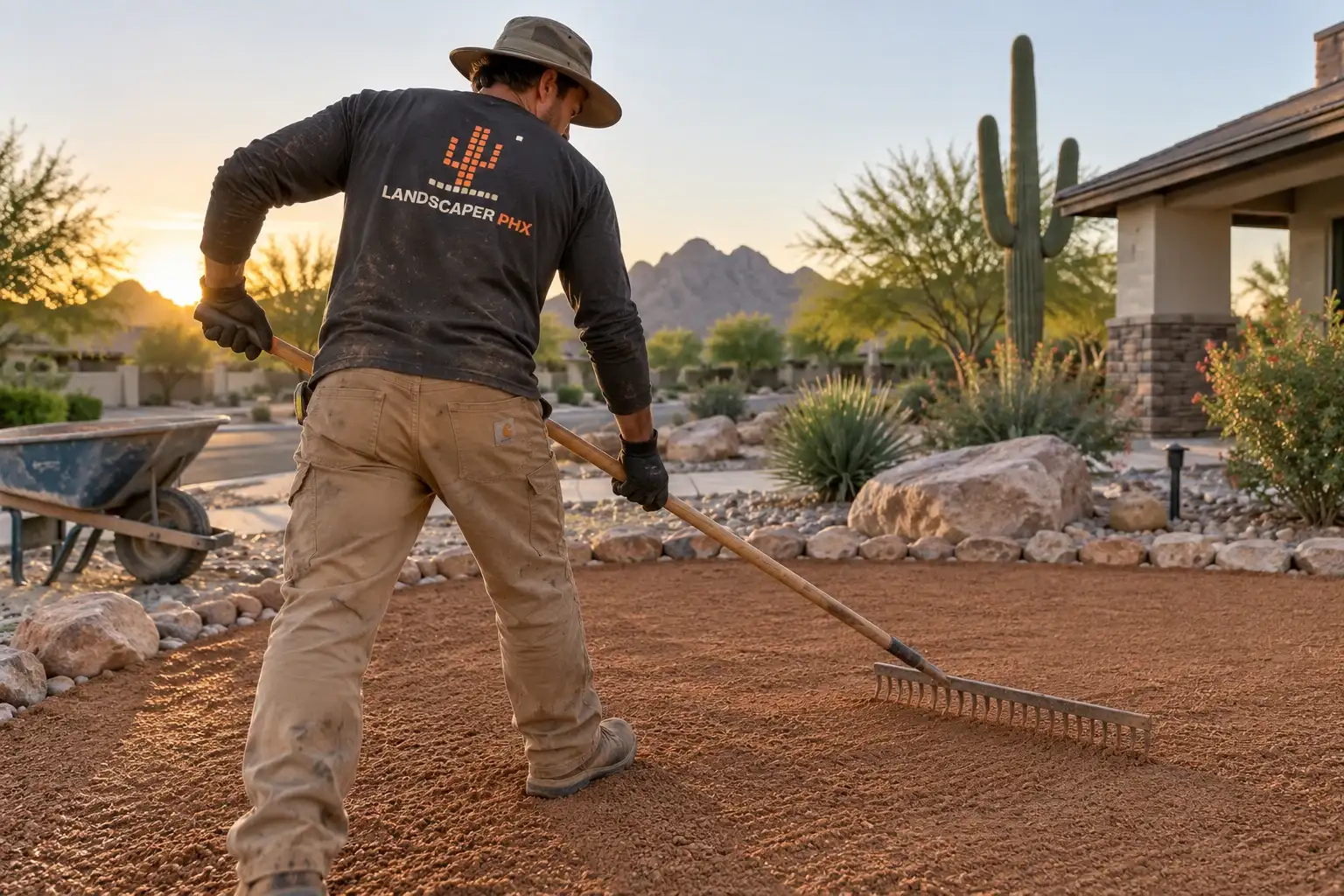
Landscaper in a Landscaper PHX shirt raking decomposed granite in a front yard at sunrise
Prefer to call?Call (747) 243-2089

Serving Phoenix, AZ

Tell us what the yard needs

Tick the services, then leave your name, number and ZIP code (city optional). Someone will call you back to talk it through.

Thank you. You will be called back soon.

Services you need Pick one or more

01Landscape design

02Sprinkler repair

03Artificial turf

04Pavers and hardscape

05Desert landscaping

01Published ranges

What does landscaping cost in Phoenix?

  • Front yard landscaping$1,500to$5,000
  • Artificial turf$3,244to$8,714
  • Paver patio$480to$22,500
  • Sprinkler repair$137to$422

Most projects land between $1,248 and $6,068, with a national average of $3,516 across 32,752 projects (a national cost guide, 2026). The same guides put work at $4.50 to $12 per square foot and a 2 person crew at $50 to $100 per hour (a national cost guide, 2026).

ProjectPublished range
Front yard landscaping$1,500 to $5,000
Full backyard renovation$15,000 to $50,000
Per square foot$4.50 to $12
2 person crew per hour$50 to $100
New landscape installation$3,000 to $16,000
Artificial turf$3,244 to $8,714, materials $2 to $8 per square foot
Paver patio$480 to $22,500, about $3,800 for 280 square feet
Sprinkler repair$137 to $422, average $278
Phoenix grass removal$2 per square foot

These are published national ranges, not a quote. The final price is set after an on-site assessment.
  1. 01 / 23

    How much should I pay a landscaper per hour?

    $50 to $100 per hour for a 2 person crew is the published range, which works out to $25 to $50 per person per hour (a national cost guide, 2026). A rate like that typically covers 2 workers, their hand tools, the truck and fuel. A crew with a trencher, a plate compactor and a dump trailer can cost more per hour than 2 people with rakes and can finish in fewer hours, so the whole job says more than the hourly figure. What the rate includes, such as haul off, base material, cleanup and any minimum charge for a short visit, belongs in the written scope. On a repair, the diagnosis matters more than the rate, because time spent guessing costs more than time spent diagnosing. Design work is often a flat fee tied to the plan rather than an hourly number.

    These are published national ranges, not a quote. The final price is set after an on-site assessment.
  2. 02 / 23

    Is $100 an hour too much for landscape work?

    No, not by itself. $100 per hour sits at the top of the published range for a 2 person crew, and it can be a reasonable number when 2 people, a truck and equipment are on site all day. It deserves a closer look when 1 person bills $100 per hour or when the hours are open ended. A per square foot price on the planting and hardscape portions, with an hourly figure kept for work that cannot be measured in advance, is easier to check against the published $4.50 to $12 per square foot. A written scope with quantities says more about value than the rate does.

    These are published national ranges, not a quote. The final price is set after an on-site assessment.
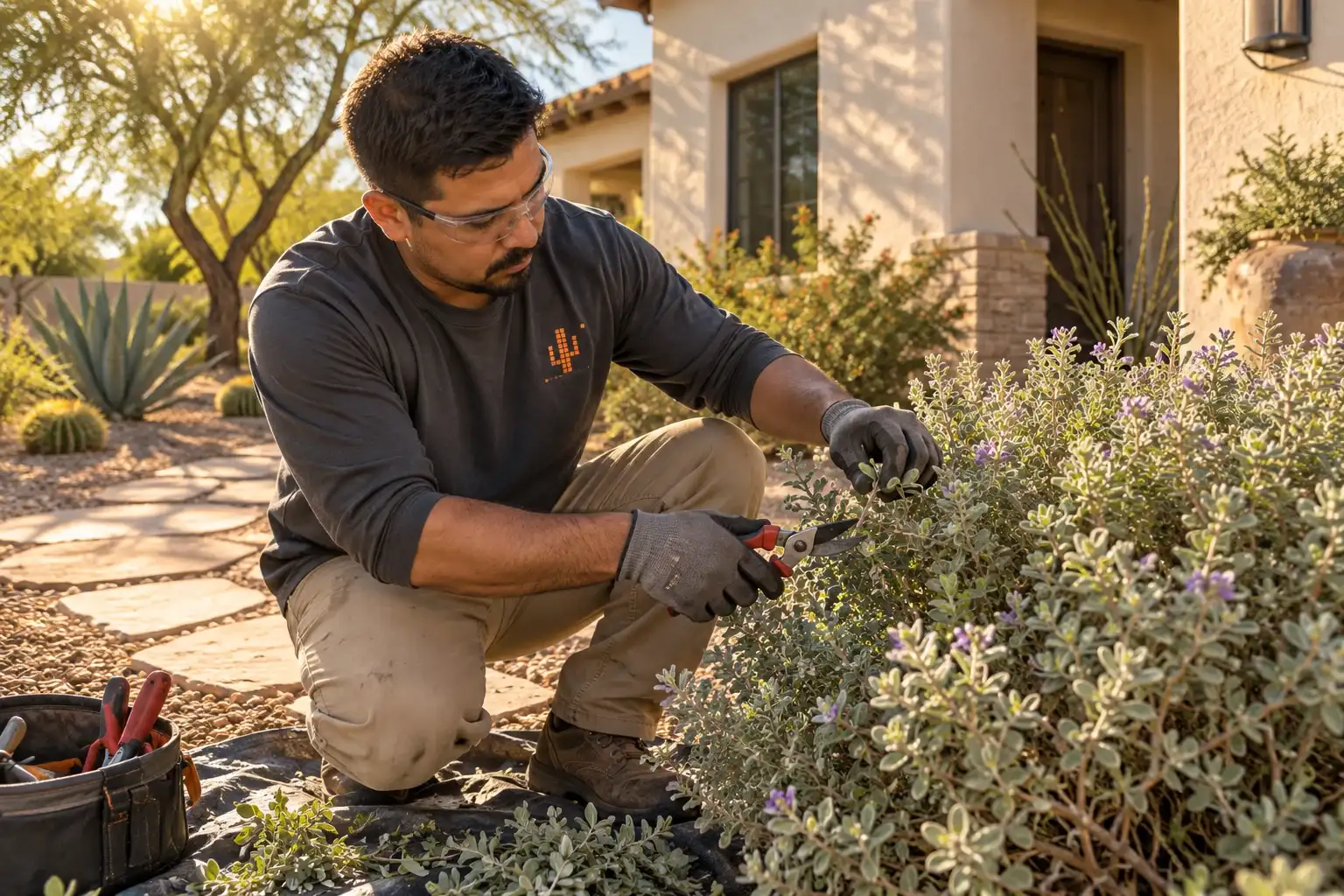
    Landscaper pruning a Texas sage shrub by hand beside a stucco house
  3. 03 / 23

    What does a Phoenix landscaper actually do?

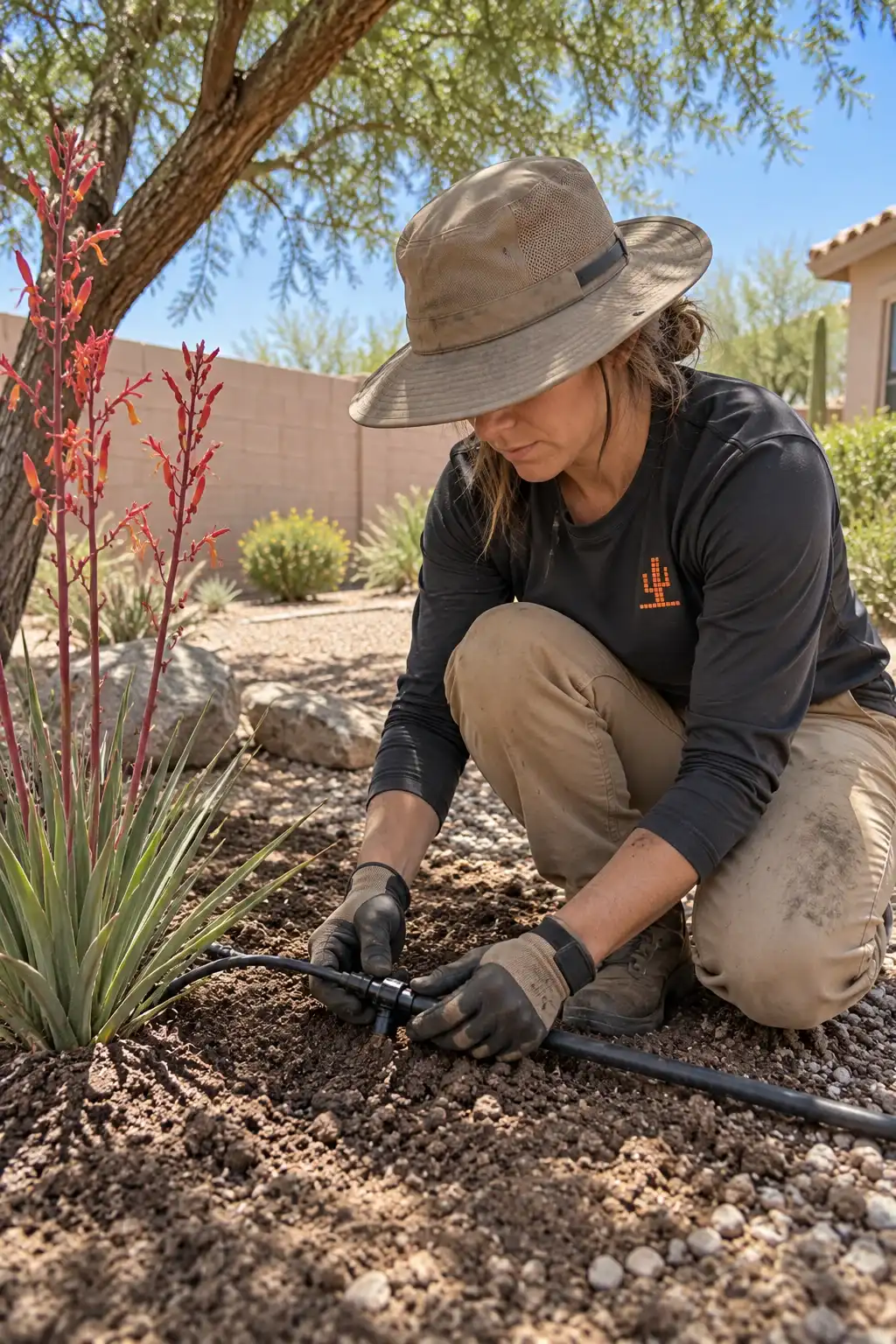
    A landscaper builds and repairs the ground around a house. That covers grading, soil work, irrigation lines, planting, turf, pavers and walls, plus the cleanup that follows. On a normal day a crew might cut out dead lawn, break caliche, run drip line to new beds, set a valve, compact base for a patio and haul the debris away. Much of the money goes into work that is out of sight once the plants are in, which is why the base and the water lines have so much to do with how the yard holds up over the first summers. It also means knowing what not to touch: the gas line, the pool plumbing, the sewer cleanout and the cable run that crosses the yard. A crew typically walks the lot before quoting, because a fence line and a slope change the plan.

  4. 04 / 23

    How do Phoenix yards differ by era?

    Many older central Phoenix yards were built around shade and lawn: narrow lots, mature trees, established irrigation and a front yard that faces the street. Newer builds to the north and south often start as bare dirt behind a block wall, with a larger lot, builder grade drip and little shade. The work differs with the era. In an older yard the work is removing or rebuilding something, and the irrigation may be decades old, with pipe that has been patched twice. In a newer yard the work starts from nothing, so the layout, the soil prep and the first planting set the pattern for years. The lot size tells you what is possible. The irrigation tells you what it will cost to keep alive. In Arcadia and other central neighborhoods, the front yard can be most of the usable yard, because the house often sits close to the street.

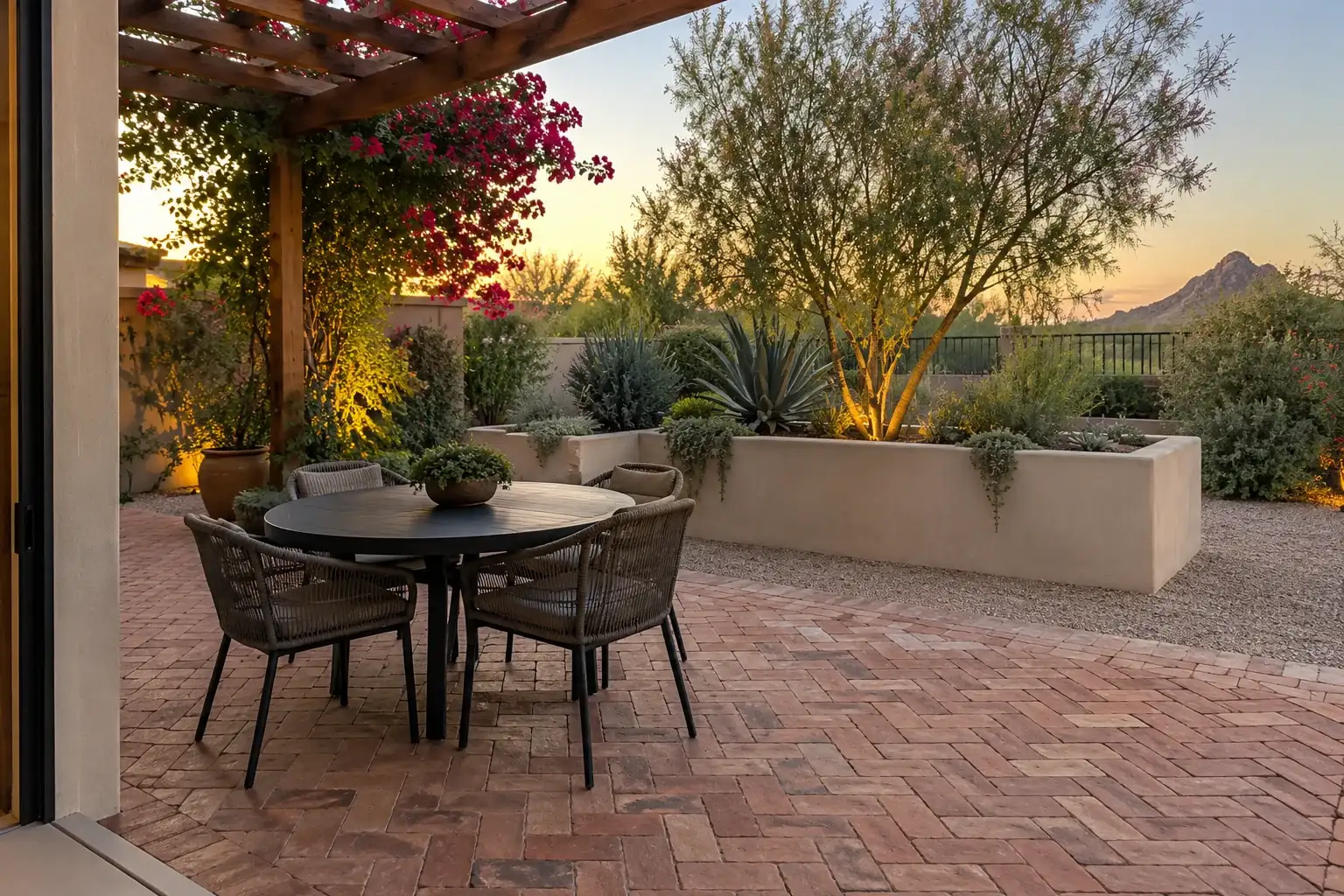
    Brick paved dining patio under a pergola with bougainvillea, a round table and desert planting at sunset
  5. 05 / 23

    Why does grass struggle here?

    Grass struggles in Phoenix because heat, soil and water cost arrive together. Summer sun on a south facing lawn can pull water faster than many sprinkler schedules replace it, and caliche under the root zone can hold water in one spot and block it in another. Up to 70 percent of the water used at home goes outdoors (Phoenix Water Services (opens in a new tab)), so a lawn that is half dead still bills every month. Phoenix sits in USDA zones 9b and 10a, where average annual extreme lows run 25 to 35 F (USDA Plant Hardiness Zone Map, 2023), which tells you winter cold is not the thing killing the grass. A lawn that looked fine in April can be gone by July. The same schedule that drowned it in March can starve it in June. A common answer is less lawn, better heads and a schedule built around the plant.

  6. 06 / 23

    What does grass to desert conversion cost?

    The city side is simple: Phoenix pays $2 per square foot for grass removal, so 1,000 square feet of lawn is a $2,000 payment if the application is approved (Residential Grass Removal Program (opens in a new tab)). The work itself is quoted separately, and the price depends on access, how much caliche has to be broken, whether the existing irrigation can be reused, and how many plants go in. A national cost guide puts basic landscaping at $4.50 to $12 per square foot, and the city payment is separate from the bid rather than a discount on it. Work cannot start until the Notice to Proceed arrives, so the paperwork sets the schedule. What happens to the old turf and to the irrigation that fed it belongs in the scope.

    These are published national ranges, not a quote. The final price is set after an on-site assessment.
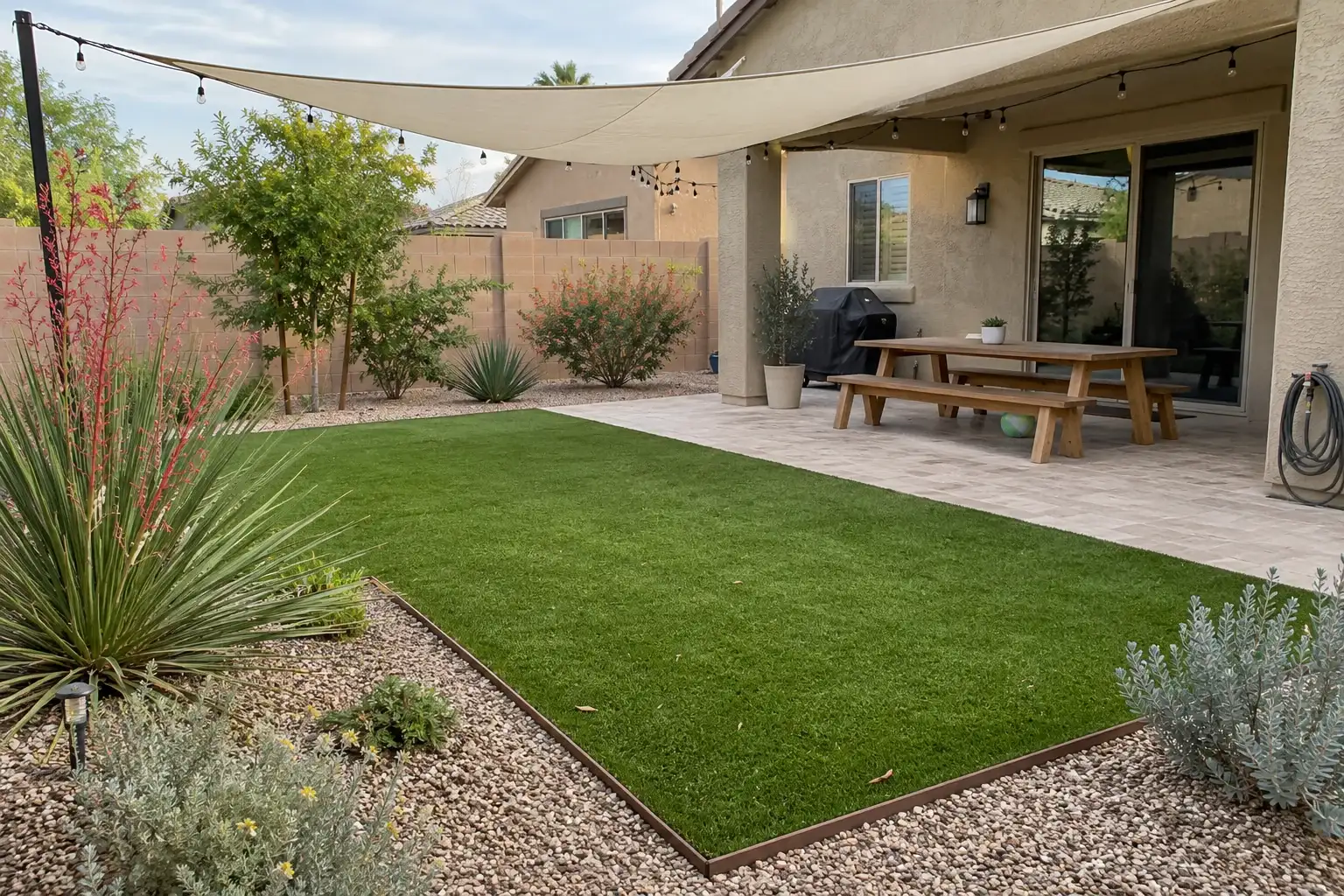
    Compact backyard with a strip of artificial turf, a shade sail, a picnic table and desert planting
  7. 07 / 23

    Does Phoenix pay for grass removal?

    Yes, through the Residential Grass Removal Program, at $2 per square foot. The applicant must own the home and pay a city services bill. Pre-approval is required, and work cannot start until the city issues a Notice to Proceed. Review can take up to 3 weeks. The grass has to be alive and healthy at a minimum of 75 percent density to be eligible, dormant grass included, so do not spray, scrape or cover it first. The same program page notes that desert plants can lower outdoor water use by 85 percent compared with grass. Areas of bare soil or weeds must be less than 25 percent of the area of grass removal. Keeping the lawn alive while the application is pending protects the density count. Once the Notice arrives, removal can be scheduled with the planting that follows.

  8. 08 / 23

    What does artificial turf cost in Phoenix?

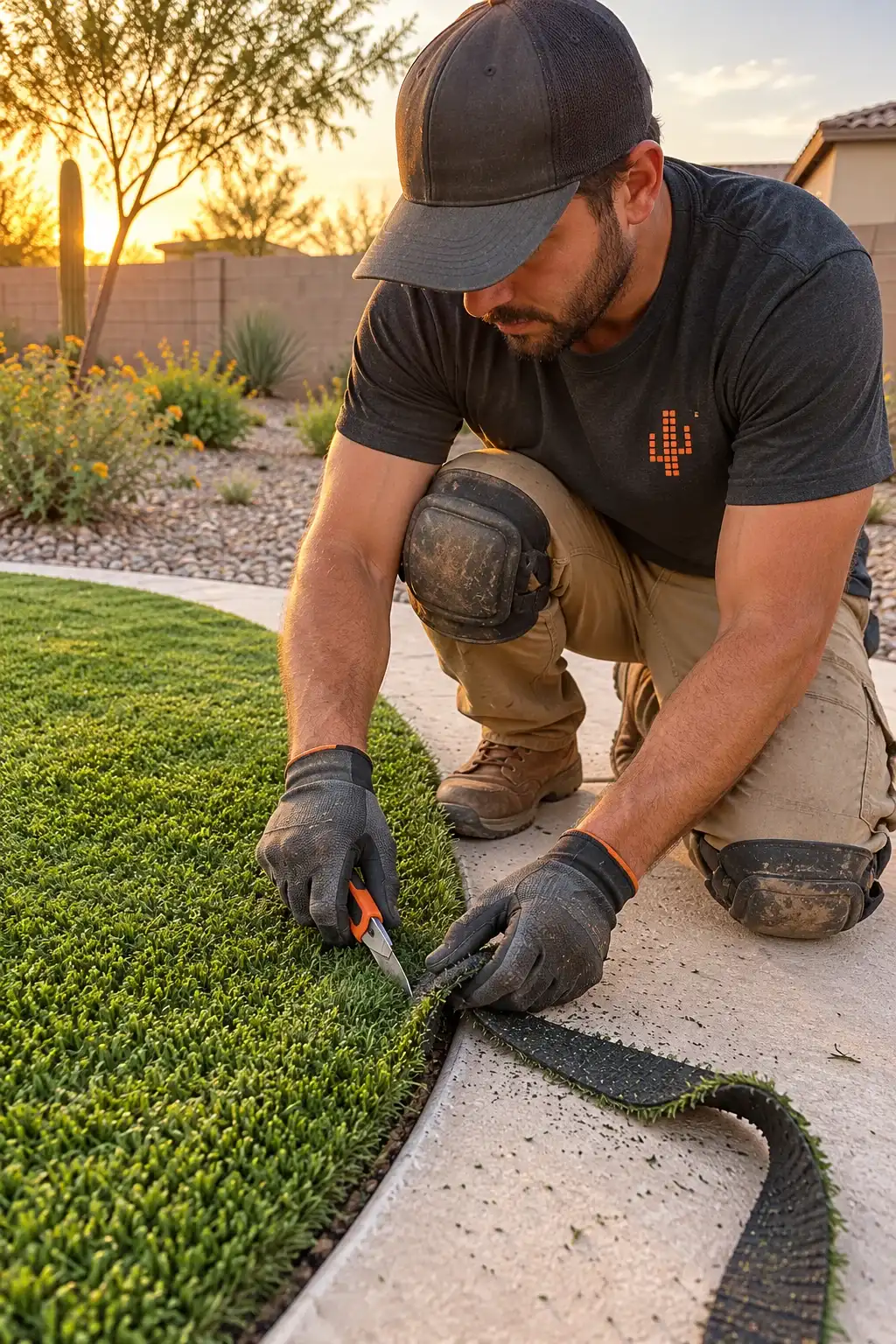
    Artificial turf averages $5,783, with most projects between $3,244 and $8,714 (a national cost guide, 2026). Materials run $2 to $8 per square foot, and the rest of the price is base, compaction, cutting and seams. The number that moves most is the base, not the turf: several inches of compacted aggregate over a graded, drained subgrade, with edge restraint that holds the perimeter. A yard with poor drainage, a slab to tie into or tight access costs more than a flat rectangle. Pet areas add infill and a drainage detail. What sits under the sample matters, because a tuft that looks right in a showroom can read flat in full sun. Fiber height, face weight and backing all change the price, and a thin roll can fade sooner.

    These are published national ranges, not a quote. The final price is set after an on-site assessment.
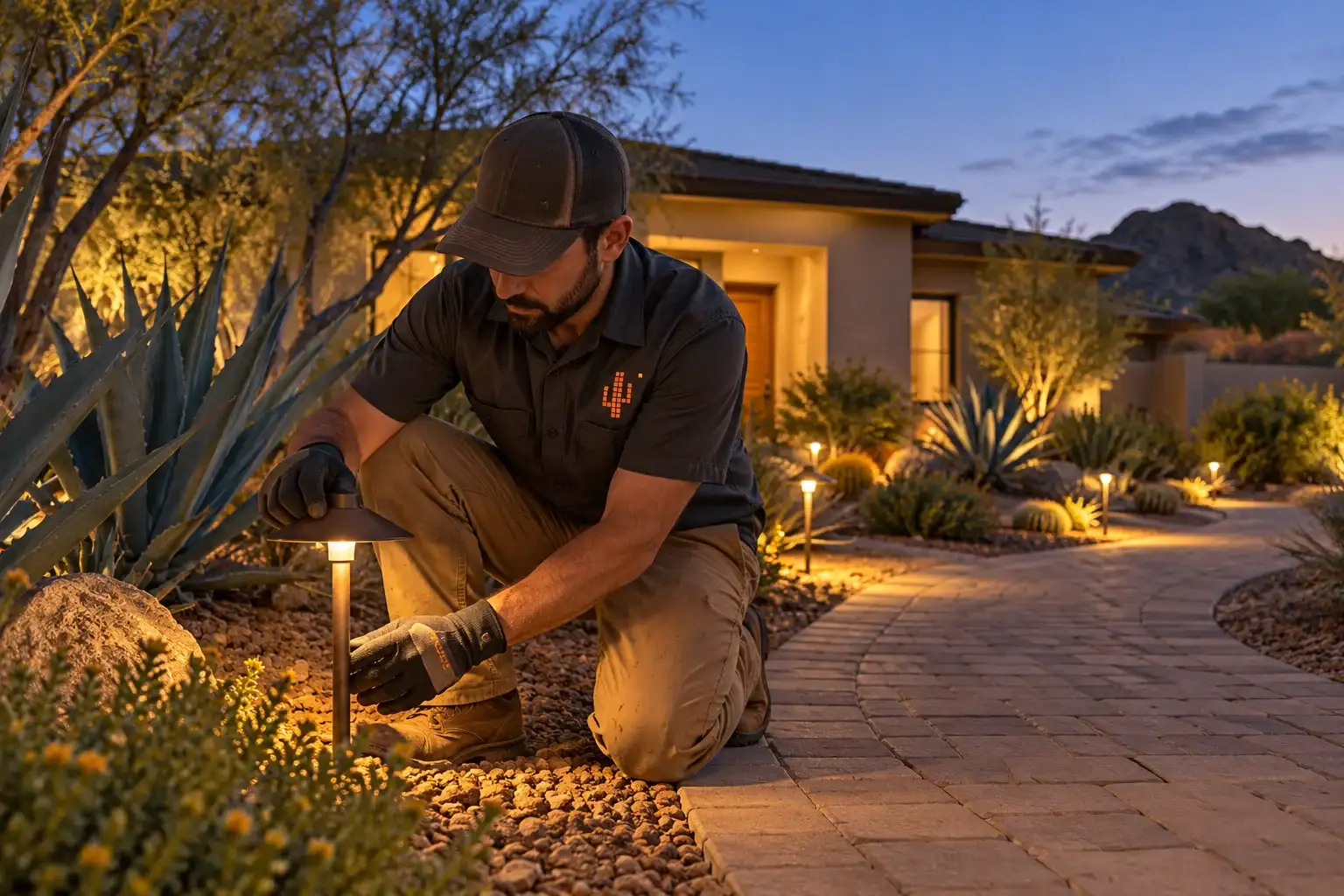
    Landscaper adjusting a path light beside agaves on a paver walk at twilight
  9. 09 / 23

    Is artificial turf worth it in Phoenix heat?

    Turf stays usable in Phoenix heat, but it gets hot under direct summer sun, hot enough that bare feet and paws complain. It cools once it is shaded or wet down, and it does not need mowing or seasonal replanting. The trade is upfront cost against a lawn's water bill and weekly maintenance. Turf makes the most sense in small yards, pet runs, putting greens and narrow strips that are hard to irrigate well. It makes less sense across a large unshaded yard, where a planted desert garden can cost less to install and stay cooler underfoot. In a yard with trees, turf can hold up better than lawn, because it does not need sun to fill in. In full exposure, expect to rinse it and to keep the dog off it in the afternoon.

  10. 10 / 23

    Do pavers work in Phoenix soil?

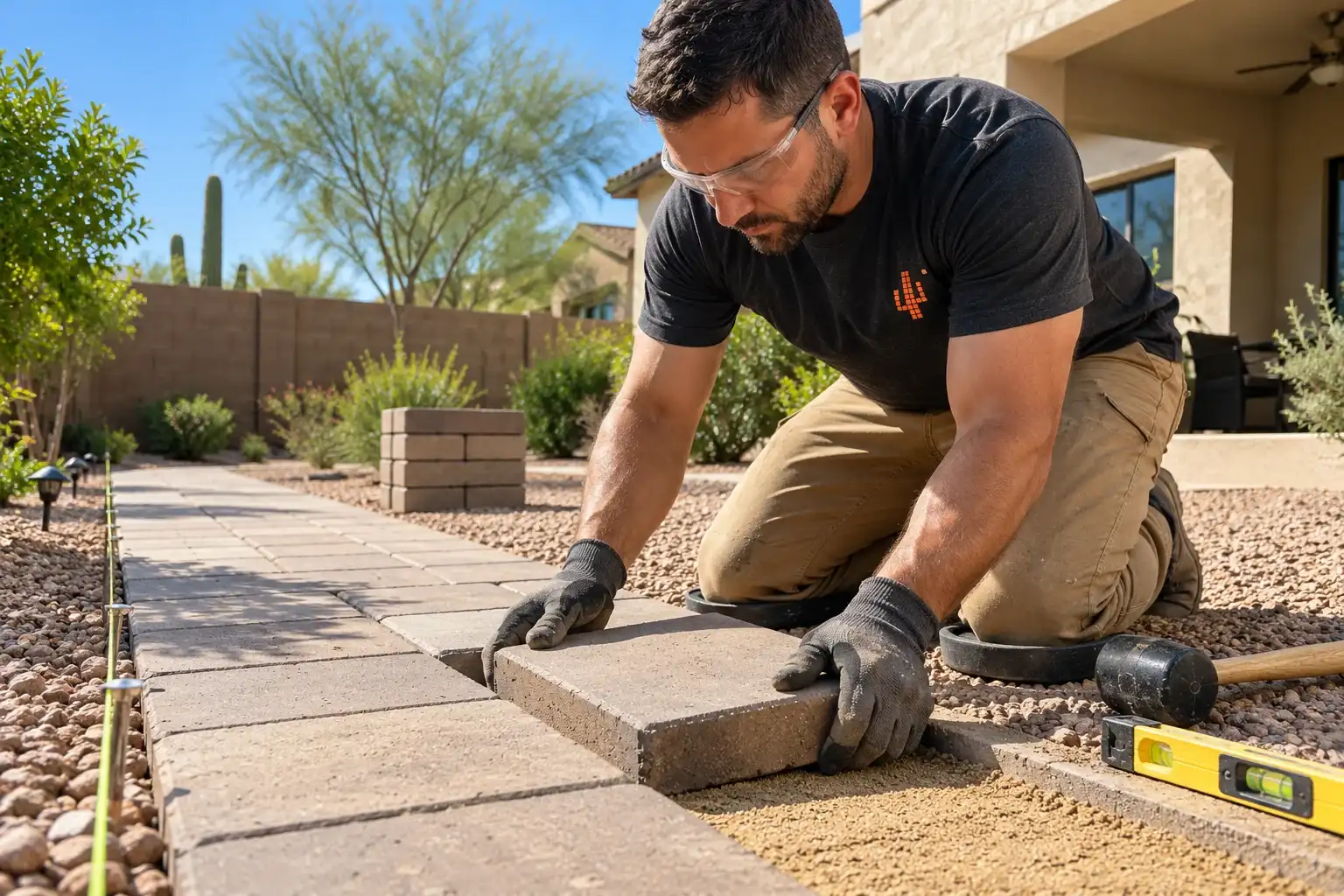
    Yes, if the base is built for the soil. Phoenix yards often sit on caliche or on fill left by a builder, and both behave differently from the dirt a patio wants under it. A sound install excavates to depth, breaks the hard layer, compacts road base in lifts, then sets the pavers on bedding sand with edge restraint. Skipping the base is a common reason patios rock, settle and grow weeds. Slope matters as much as depth: a patio has to shed monsoon rain away from the house, not toward the slab. Expansion matters too, because a large paver field moves with heat and needs joints that can take it. A compacted edge and a restraint buried at the perimeter keep the field from spreading. On a slope, steps and a footing do the work that a flat yard does with grade.

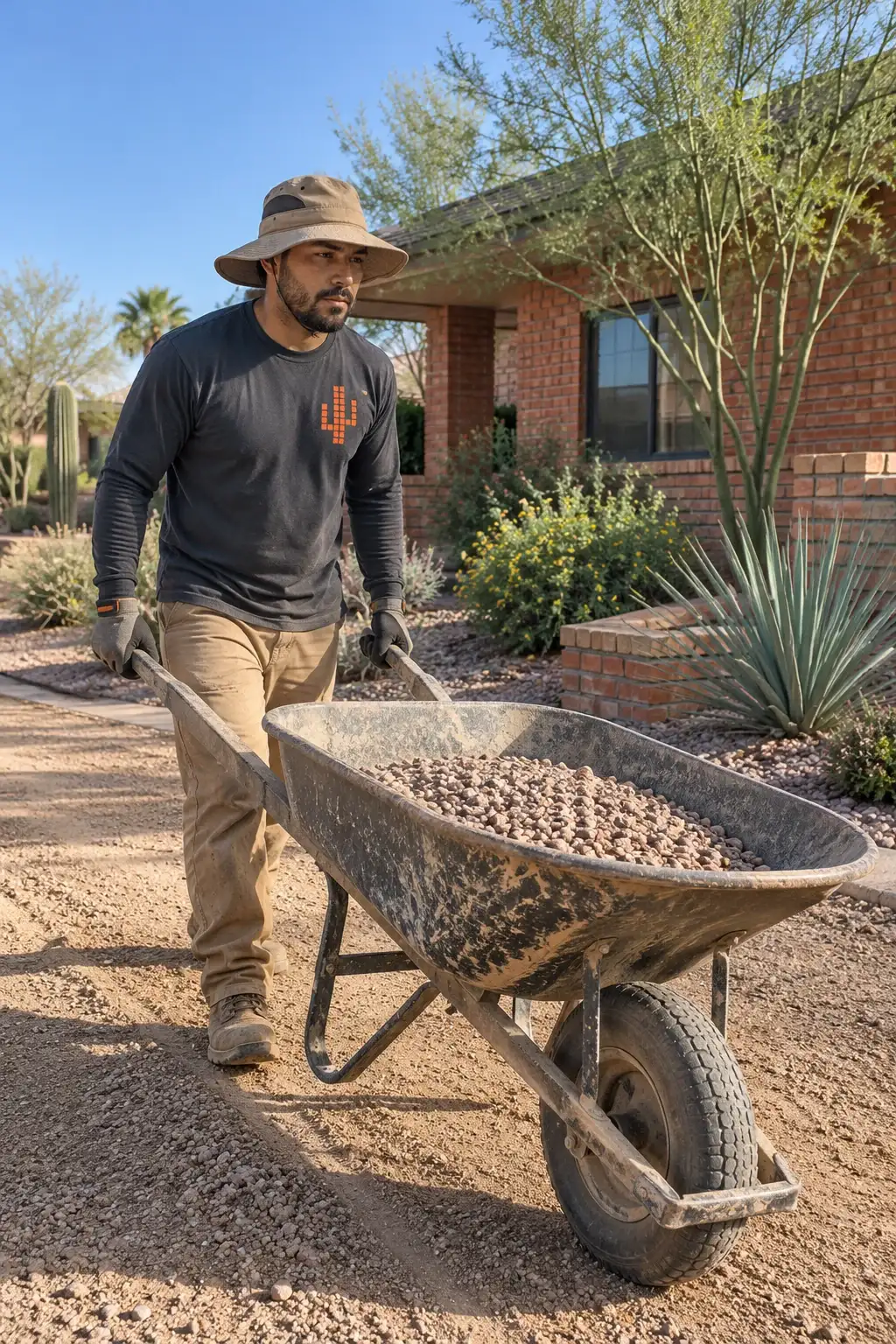
    Landscaper pushing a wheelbarrow of gravel along a desert front yard in the morning
  11. 11 / 23

    What does a paver patio cost?

    A paver patio averages about $3,800 for 280 square feet, with a published range of $480 to $22,500 and $8 to $50 per square foot (a national cost guide, 2026). The low end is a small pad in a common paver; the high end is natural stone, complex cuts, steps and walls. Demolition, haul off, base depth and access all sit on top of the material price. A patio against the house with 2 steps and a seat wall is a different job from a bare rectangle in the middle of the yard. Whether the price includes the base, the edge restraint and the polymeric sand is worth settling in the scope, because those 3 items change the total. Who hauls the old concrete, and whether the dumpster sits on the driveway or the street, belongs in the scope too.

    These are published national ranges, not a quote. The final price is set after an on-site assessment.
  • $2per square footpaid by the Phoenix grass removal programSource: City of Phoenix
  • 70%of home watergoes outdoors in PhoenixSource: Phoenix Water Services
  • 9b/10aUSDA zoneswinter cold is mild, summer heat sets the limitsSource: USDA Plant Hardiness Zone Map, 2023
  1. 12 / 23

    Why do sprinklers fail here?

    Many failures come from water, sun and soil movement. Hard water scales up heads and nozzles until the spray pattern collapses into a weak stream. Plastic bodies go brittle after years of ultraviolet light and crack at the riser. Valves stick when grit gets past the diaphragm, and a stuck valve leaves a zone running until someone walks outside and hears it. Tree roots shift pipe, and caliche makes a small leak dig its own channel. A controller left on a summer schedule then soaks a yard that needed half the run time. A zone that sprays the block wall or the sidewalk loses water every cycle, and that shows up as a dry bed and a high bill at the same time. Watch for a head that stays up after the zone shuts off, which points at a valve.

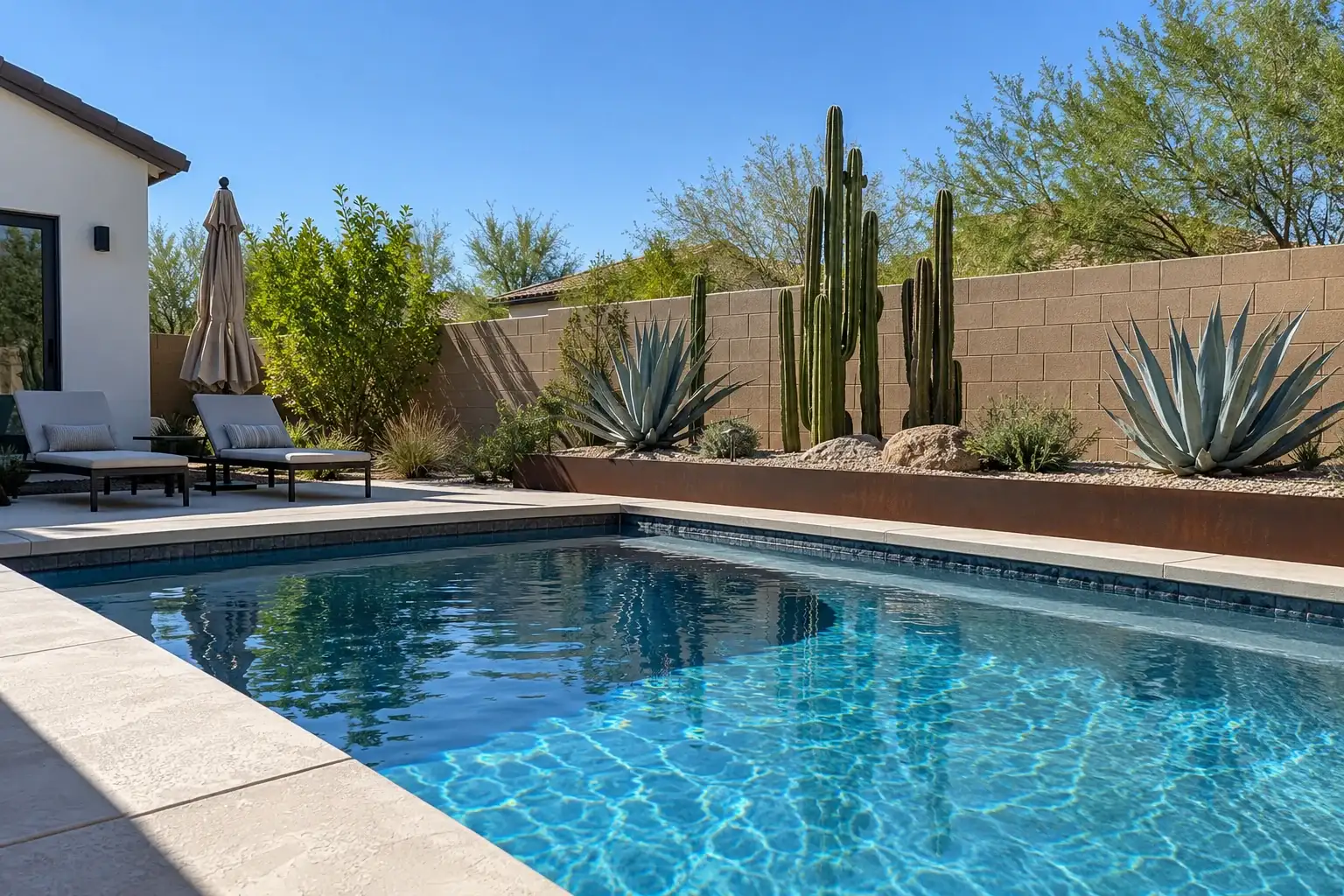
    Poolside garden with saguaro and agaves in a raised gravel bed beside a blue pool
  2. 13 / 23

    What does sprinkler repair cost?

    Sprinkler repair averages $278, and most repairs fall between $137 and $422 (a national cost guide, 2026, 36,233 projects). A single broken head is a small repair; a valve replacement, a line break under a patio or a controller swap is a larger one. The price is mostly labor and access, so a repair that needs digging costs more than one at the surface. A written diagnosis before the work starts keeps a head swap from turning into a line replacement on the invoice. A repair that turns into a reroute is priced from the trench, not the head, so the diagnosis decides the number. A pressure test of the zone after the fix is worth including in the scope.

    These are published national ranges, not a quote. The final price is set after an on-site assessment.
  3. 14 / 23

    What is the difference between landscaping and yard maintenance?

    Landscaping is a project with a start and a finish: design, grading, irrigation, planting, turf and pavers. Yard maintenance is the recurring work that keeps the result alive: mowing, edging, trimming, blowing, weeding and checking that water lands where it should. The 2 are priced differently. A project is quoted from a plan and measured in square feet or by the item, while maintenance is quoted per visit or per hour and depends on the size of the yard and how often the crew comes. Many yards need both at different times, and a good install can make the maintenance cheaper. A maintenance visit can also catch a broken head or a failing valve early, which can cost less than a repair call later. The 2 differ in materials as well: a project carries a plant list, while maintenance carries blades, line and fertilizer.

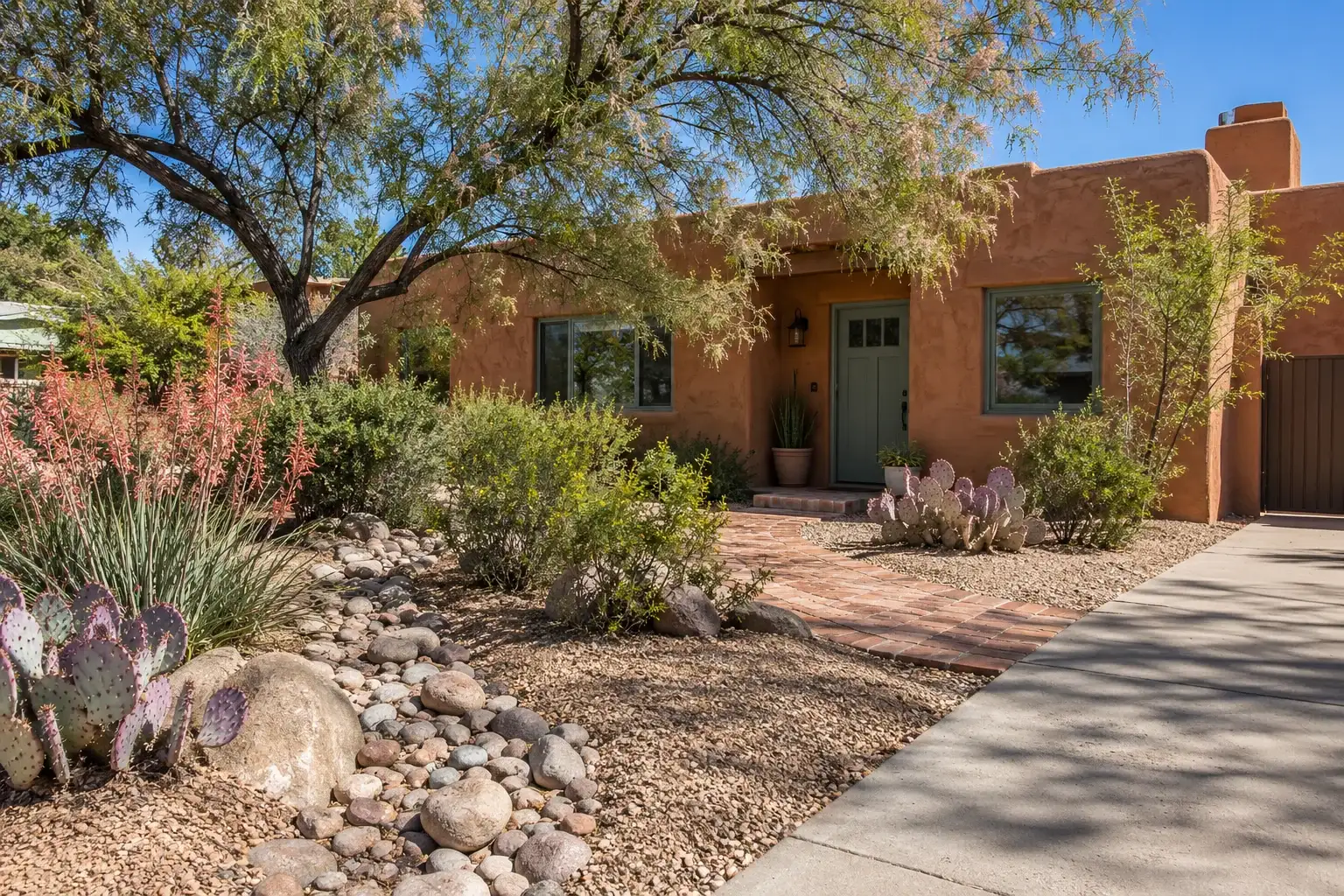
    Adobe house entry with a dry river rock swale, flowering desert plants and a concrete walk at midday
  4. 15 / 23

    How much is yard maintenance per hour?

    A 2 person crew bills $50 to $100 per hour (a national cost guide, 2026), and maintenance visits can be priced from an hourly rate or as a flat fee per visit. What changes the number is frequency, yard size, how much trimming there is and whether the crew hauls debris. What a visit includes matters when 2 prices are compared. A low rate that covers mowing only is not cheaper than a higher rate that also edges, trims, blows and checks the irrigation. Monthly billing is common on recurring work, and a written list of tasks keeps the visits consistent. On a small yard, a flat visit fee is easier to budget than an hourly number that moves with the crew. Winter visits can cost less than summer ones when growth slows.

    These are published national ranges, not a quote. The final price is set after an on-site assessment.
  5. 16 / 23

    How much water does a Phoenix yard use?

    Up to 70 percent of the water used at home in Phoenix goes outdoors, according to the city's own guidance (Phoenix Water Services (opens in a new tab)). That makes the yard a major place for a household to cut use. The same page makes the point that watering to plant need saves money and keeps plants healthier, which is the opposite of running every zone for the same length of time. The fix is often a zone by zone schedule, matched heads and a check that nothing is spraying the block wall. A leak in a valve box or a head pointed at the wall can waste a lot of water. Reading the water bill across 2 months before and after a schedule change shows the effect. Drip on its own valve gives you the control that lawn and desert beds both need.

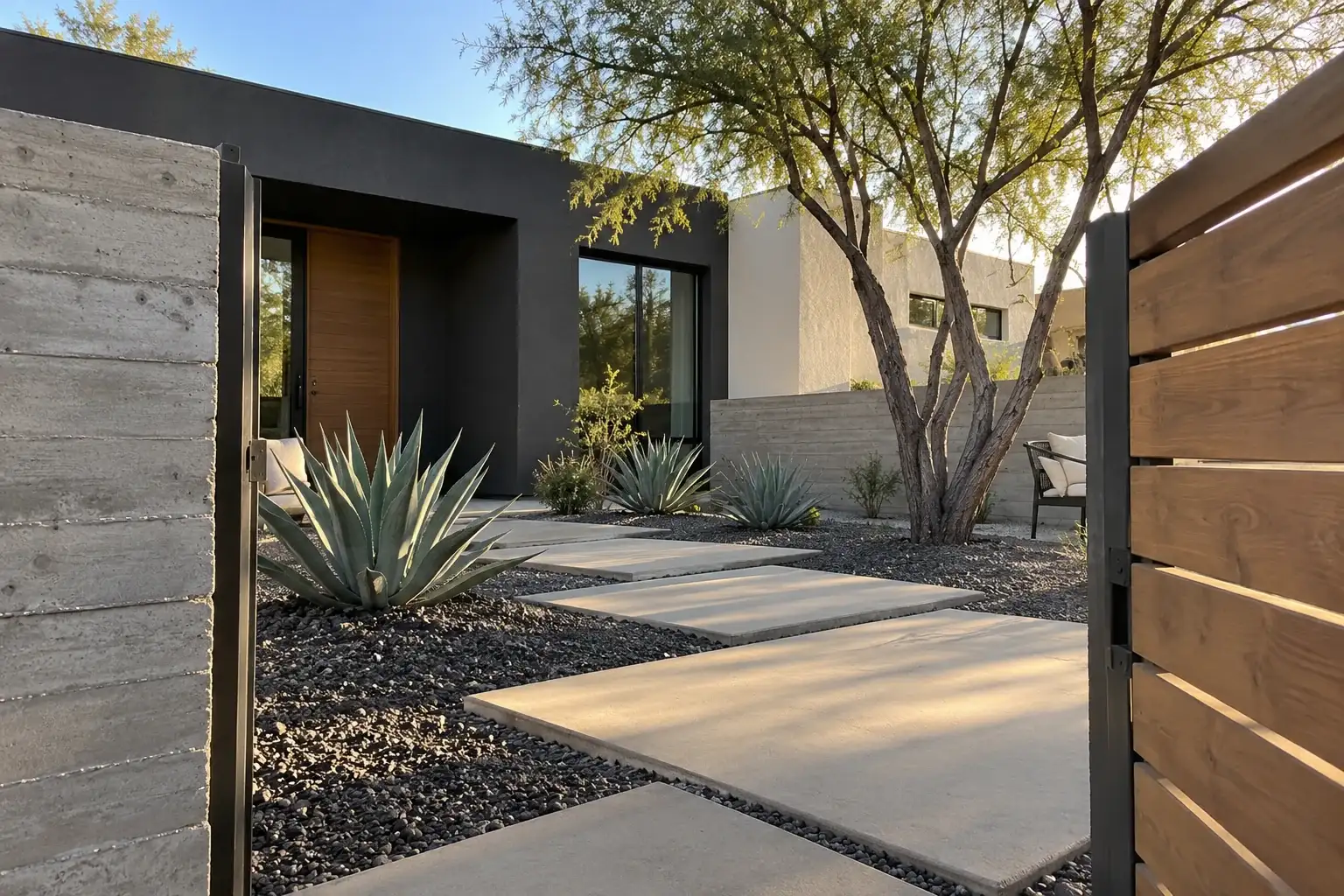
    Contemporary courtyard with concrete stepping slabs, agaves and gravel beside a wood slat gate
  6. 17 / 23

    What planting zone is Phoenix in?

    Phoenix is in USDA zones 9b and 10a on the 2023 map, with an average annual extreme minimum of 25 to 30 F in 9b and 30 to 35 F in 10a (USDA Plant Hardiness Zone Map, 2023). That tells you winter cold will not kill most desert plants, and it tells you almost nothing about summer. The real limits here are reflected heat off block walls and pavement, weeks above 100 F, and soil that drains fast in one spot and not at all in another. Choose plants for heat and soil first, then use the zone for the few nights a year that dip toward freezing. In these zones the cold that does arrive comes at night and leaves by mid morning, so damage tends to show on the newest growth. Cover tender plants on those nights with a sheet, not plastic. The bigger risk to a Phoenix planting is a June that arrives before the roots do.

  7. 18 / 23

    Which plants handle Phoenix heat?

    The reliable group is desert natives and long adapted plants: palo verde, mesquite, ocotillo, desert spoon, agave, aloe, lantana, bougainvillea, Texas sage and desert marigold. They take full sun and reflected heat once established, and most want deep, infrequent water rather than a daily sprinkle. Group them by water need so one valve does not serve a cactus and a fern. Trees go on the west and south sides, where shade does the most work on the house. Keep a clear zone against the wall for maintenance access and for fire safety. Give each plant room at maturity, because a palo verde set close to a wall can become a problem as it matures. Keep the mass planting simple, since a bed with 12 species is hard to water well. New plants may need hand watering through the first summer, even with drip.

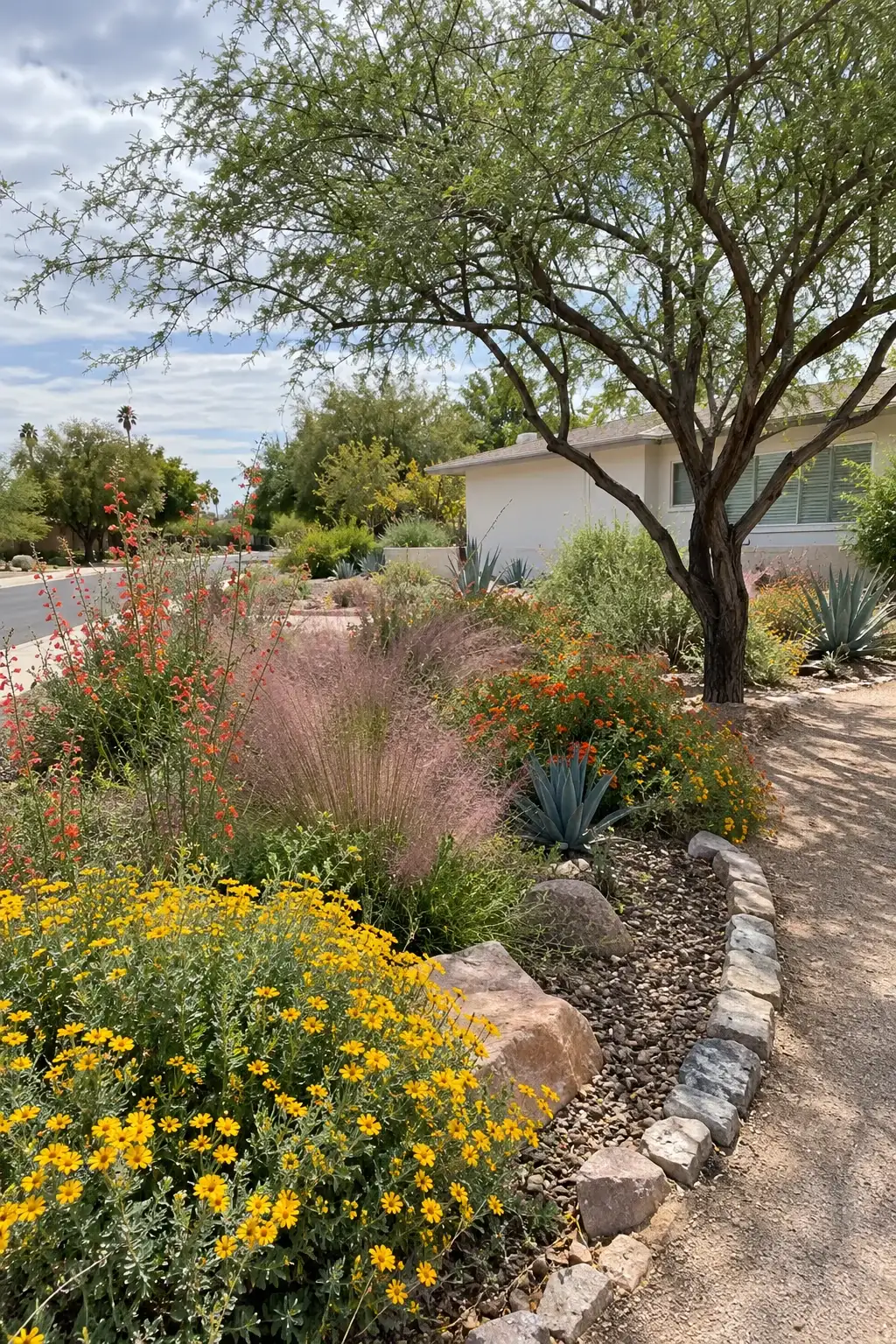
    Colorful desert garden with yellow and pink flowers, grasses and an ironwood tree beside a gravel walk
  8. 19 / 23

    What is caliche and why does it matter here?

    Caliche is a soil layer cemented together by calcium carbonate, from a few inches to several feet thick. It looks like pale rock and behaves like weak concrete. Water can pool on top of it, roots can be blocked by it, and a shovel rings off it. A planting bed, patio base or drainage line that meets caliche often needs it broken and removed, not just soaked. University of Arizona guidance for planting holes is to penetrate completely through the caliche layer so water can drain (University of Arizona Cooperative Extension, managing caliche (opens in a new tab)). That is one reason a Phoenix install can cost more than the same square footage in softer ground, and why a site visit matters before a price is fixed. The layer can be thick in one corner of a lot and absent a short distance away, so a single test hole tells you little. Where it sits close to the surface, a raised bed can cost less than breaking it out.

  9. 20 / 23

    What happens to a Phoenix yard in monsoon season?

    Summer storms arrive fast, drop a lot of water in a short time and leave. A yard that slopes toward the house, a patio without fall, or a bed filled above the top of the wall can show the problem in the first storm. Water crossing a lot can cut a channel through gravel and pile it against the block wall. Before the season, check that the patio drains away from the slab, that no bed sits above the weep line, and that the controller is set to stay off during rain. After a storm, walk the yard and look for new low spots. Gutters and downspouts that dump against the wall are a common cause of a wet patch that stays damp. A shallow swale can move water around a bed instead of through it.

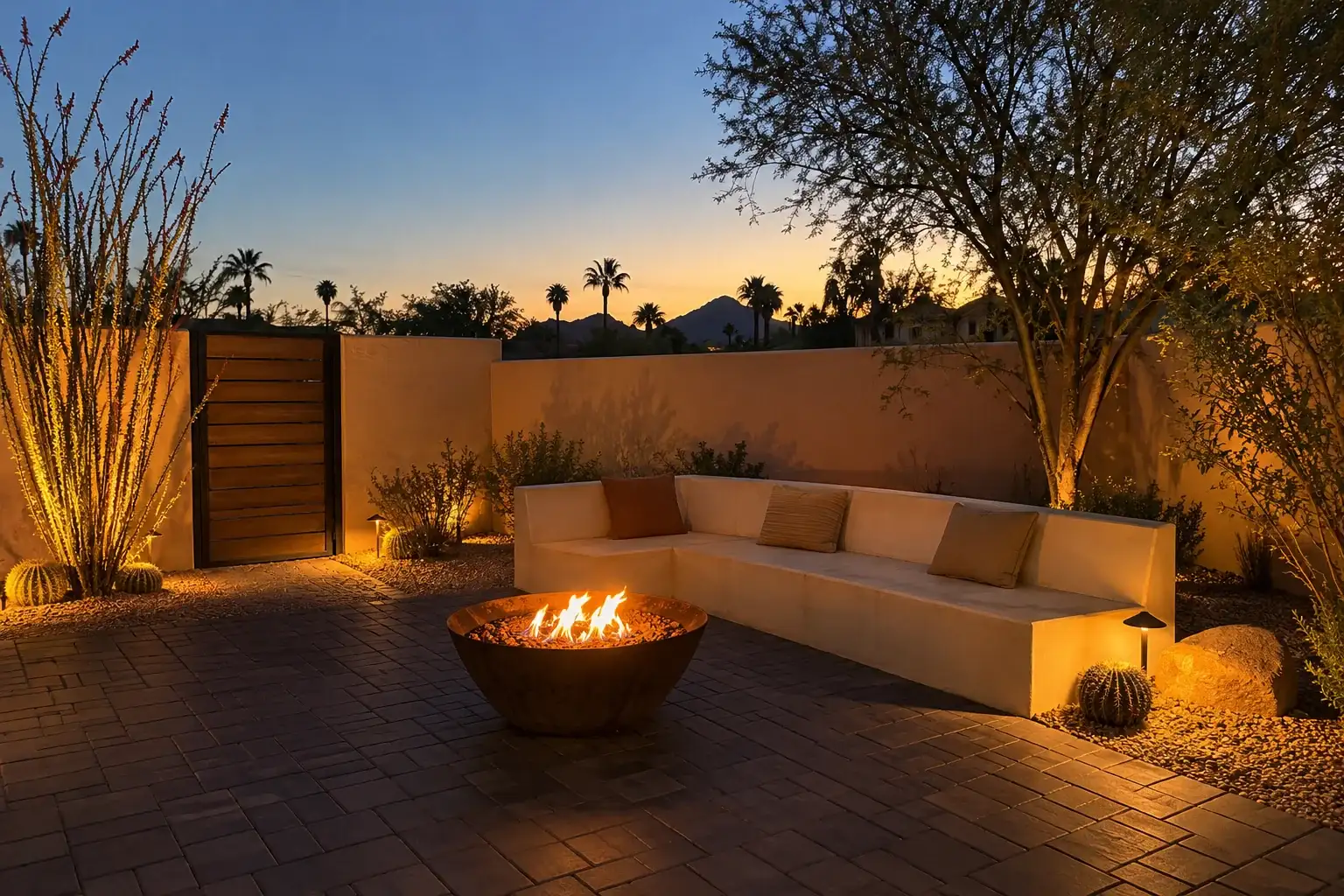
    Desert patio at dusk with built-in seating, a fire bowl and warm lights along the wall
  10. 21 / 23

    What does the process look like from first call to finished yard?

    It starts with a call to (747) 243-2089. The first questions are the ZIP code, what the yard is doing now and roughly how big the area is. Then comes a site visit: the area is measured, the irrigation is checked, the soil and the slope are looked at, and what the yard needs to do is talked through. From there a scope arrives with quantities and a price per item. Once the scope is approved, the work gets scheduled. The work runs in order: demo and haul off, grading and base, irrigation, hardscape, planting and turf, cleanup, then a walkthrough with the controller set. The price should be known before demo starts, and the change process should be on paper. If a wall or a tree turns up where the plan expected open ground, the change gets priced before work continues. The last walkthrough covers the controller, the valves and the plant list.

  11. 22 / 23

    What should a Phoenix landscaping scope include?

    A written scope should list the square footage, the plant list with sizes, the irrigation zones, the paver type and the base depth, so the price is tied to quantities. Measurements come from a site visit, because a fence line, a slope and caliche change the plan. It should also show what gets hauled away and what stays in place. A scope with quantities, plant sizes and a start date leaves little to interpret.

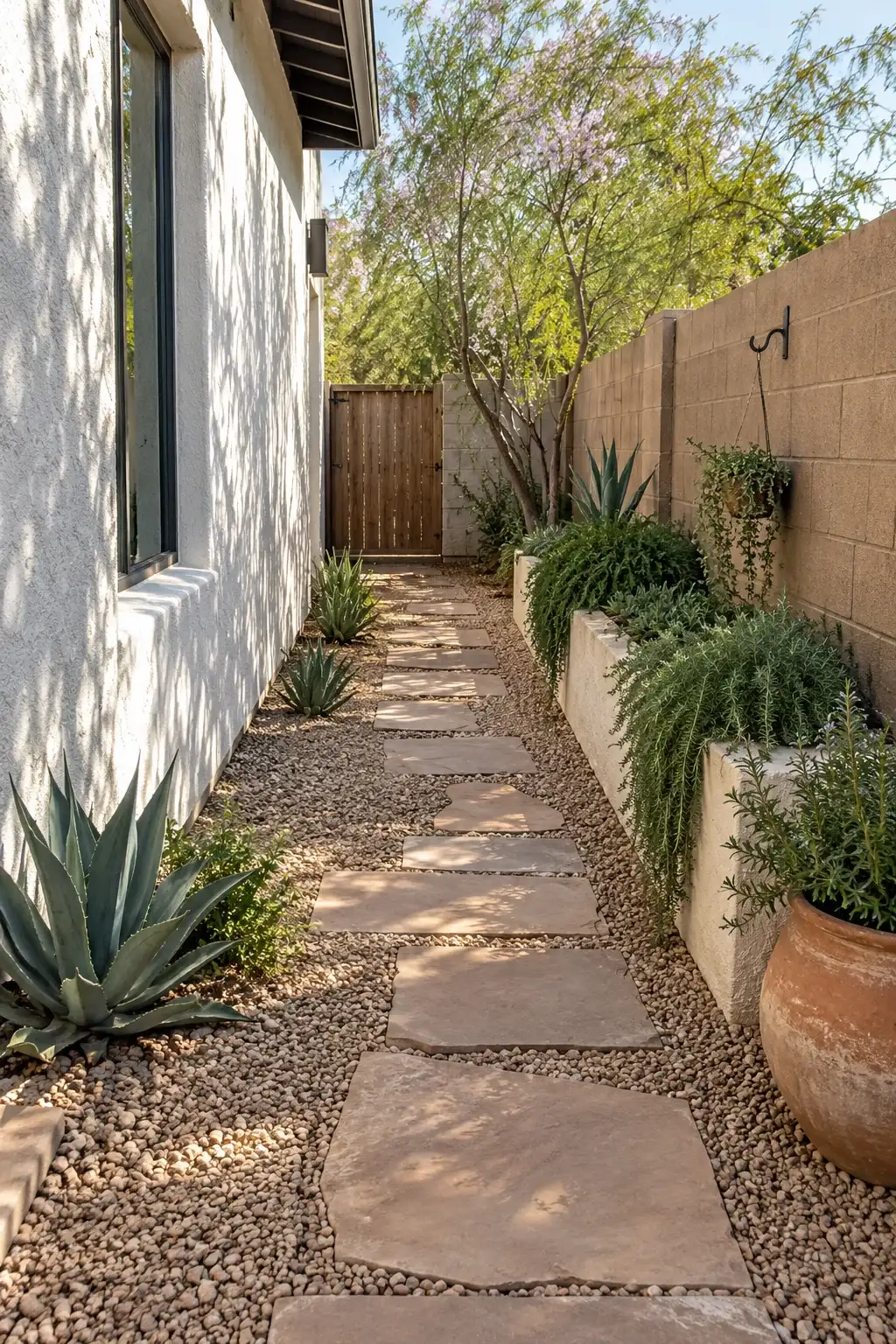
    Narrow side yard with sandstone stepping stones, gravel and planted raised beds along a block wall

25Service area

Which areas around Phoenix do you cover?

We serve Phoenix and the towns around it, including Tempe, Glendale, Scottsdale, Peoria, Ahwatukee, Laveen and North Phoenix. The lots differ from one place to the next: small lots near the university in Tempe, hillside grade in Ahwatukee, desert lots in Scottsdale, and new bare dirt in Laveen. Each area page lists the ZIP codes and the local conditions. If the yard is outside those places, send the form with the ZIP code and someone from our team will call you back.

Open in Google Maps (opens in a new tab)

23 to 23 / 23Guide

Before you sign

  1. 23 / 23

    What should a landscape contract spell out?

    A contract can spell out what is excluded, who hauls the debris, who pulls permits and what a change costs once work starts. Payment can be tied to stages rather than to a deposit and a promise. It can also say what happens if a plant fails in the first season, who handles the controller check, when the work starts and how many people will be on site. What the deposit covers and when the next payment is due belong on paper too.

277 questions

Questions people ask

Still have a question? Call (747) 243-2089 and describe the yard.

01

How much does landscaping cost per square foot in Phoenix?

Published ranges put landscaping at $4.50 to $12 per square foot, with most projects between $1,248 and $6,068. A gravel and plant bed can sit at the low end, while turf, pavers and walls can push toward the top. Measuring the area first makes it possible to check a price per square foot against the published range.

02

Does artificial turf get too hot for dogs?

Yes in direct summer sun, and less so in shade. A turf surface climbs well above air temperature on an exposed south or west facing patch. A shaded run, a section that gets a quick hose down and a lighter color all help. Infill and drainage matter if the dog uses the same strip every day.

03

Can I keep part of my lawn?

Yes. A smaller lawn in one shaded area, with desert planting everywhere else, is a common layout in Phoenix. Keep the lawn where it is used and where irrigation already reaches, and convert the strips that only get water and mowing. The city grass removal program pays on the area you remove, so measure before deciding.

04

Are small yards worth a project?

Yes. Small lots are common in central Phoenix and near the university, and a single bed, one patio or a pet run is a fine size for a project. Small yards can suit turf and pavers because the base and the access stay simple. Send the measurements and a photo.

05

What is the best time of year to plant in Phoenix?

Fall, when the air cools and the soil is still warm. Roots establish through winter and the plant meets its first summer with some size on it. Spring planting works if the drip is set up and the plant is watched through June. Avoid putting a new tree in during a heat wave unless it will be watered by hand.

06

What makes a landscaping scope easy to check?

A line item list can show square footage, plant sizes, paver type, base depth, irrigation parts and haul off. A low total with smaller plants, a thinner base or no haul off is a different job from a higher total with all of them included, so the scope and the exclusions matter more than the total.

07

Do I need a permit for a patio or a wall?

Sometimes. Whether a specific patio or wall needs a city permit depends on the structure, the height and the lot. The City of Phoenix says its requirements for fences and walls are found in the Phoenix Building Construction Code and Zoning Ordinance (City of Phoenix, residential fences and walls (opens in a new tab)). Who pulls the permit is worth settling in writing before work starts.

Talk about your yard(747) 243-2089Send a request

Before you go: want a call back?

Leave your name, phone number, ZIP code and the service you need, and someone will call you back about your yard.

Call (747) 243-2089

Thank you. You will be called back soon.