Service 04 of 05 · Phoenix, AZ
Pavers and Hardscape in Phoenix, AZ
Planning pavers and hardscape in Phoenix? Tell us about your yard, and someone from our team will call you back to talk it through.
Last updated
A paver patio, a flagstone walk or a retaining wall in Phoenix is a base problem before it is a stone problem. The excavation and the base get priced before the surface does.
01Hardscape
What does paver and hardscape work include?
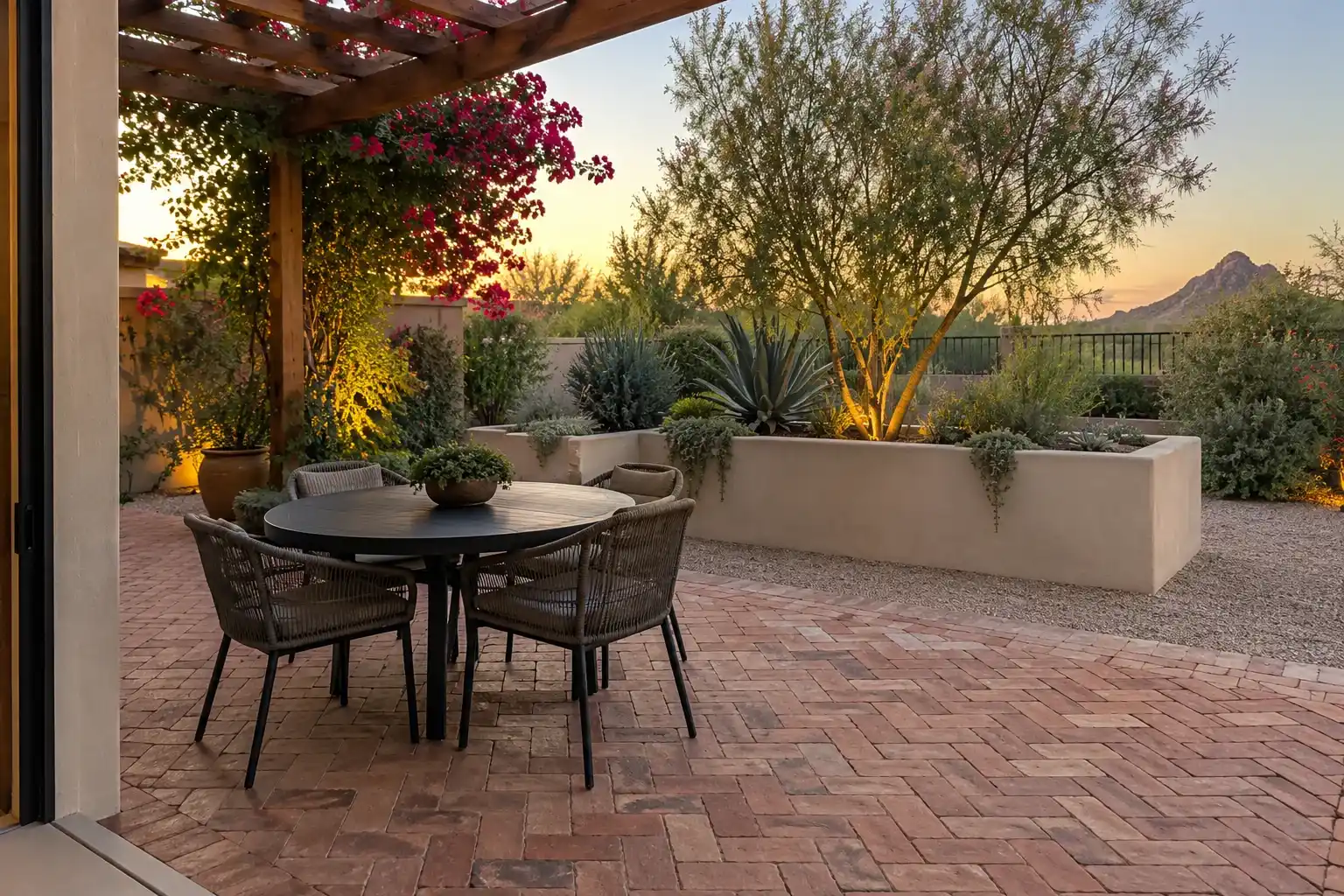
Hardscape is the flat surfaces and the walls that shape a Phoenix yard. That covers a paver patio set on a compacted base, a flagstone path, a travertine deck around a pool, a front walk from the driveway to the door, and a retaining wall where the ground steps up or down. Steps, seat walls, planters and the edging that keeps gravel off the pavement belong to it as well.
Stone is the visible part. The work underneath is aggregate base, sand and compaction in layers, plus a slope that carries water away from the house. A patio that fails has often failed at that layer, not at the surface.
New work can be tied into an existing patio or wall when the same material is still available.
02Costs
What does a paver patio cost in Phoenix?
A paver patio runs $8 to $50 per square foot, with published projects from $480 to $22,500 and an average near $3,800 for 280 square feet, according to a national cost guide. The spread is wide because the same area can be a plain square of pavers or a cut flagstone deck with steps and a seat wall.
Landscape work of all kinds is published at $4.50 to $12 per square foot, according to a national cost guide. Hardscape can sit at the upper end or above once base depth, drainage and wall footings are in the scope.
Walls price by the linear foot and by height, so a low garden wall and a tall retaining wall are separate line items.
These are published national ranges, not a quote. The final price is set after an on-site assessment.
03Contact
What happens from the first call to a finished patio?
The first visit is a walk of the yard with a tape and a level. The notes cover where water goes now, where the door sits, how the gate opens and what is buried. From that a layout gets painted on the ground and priced.
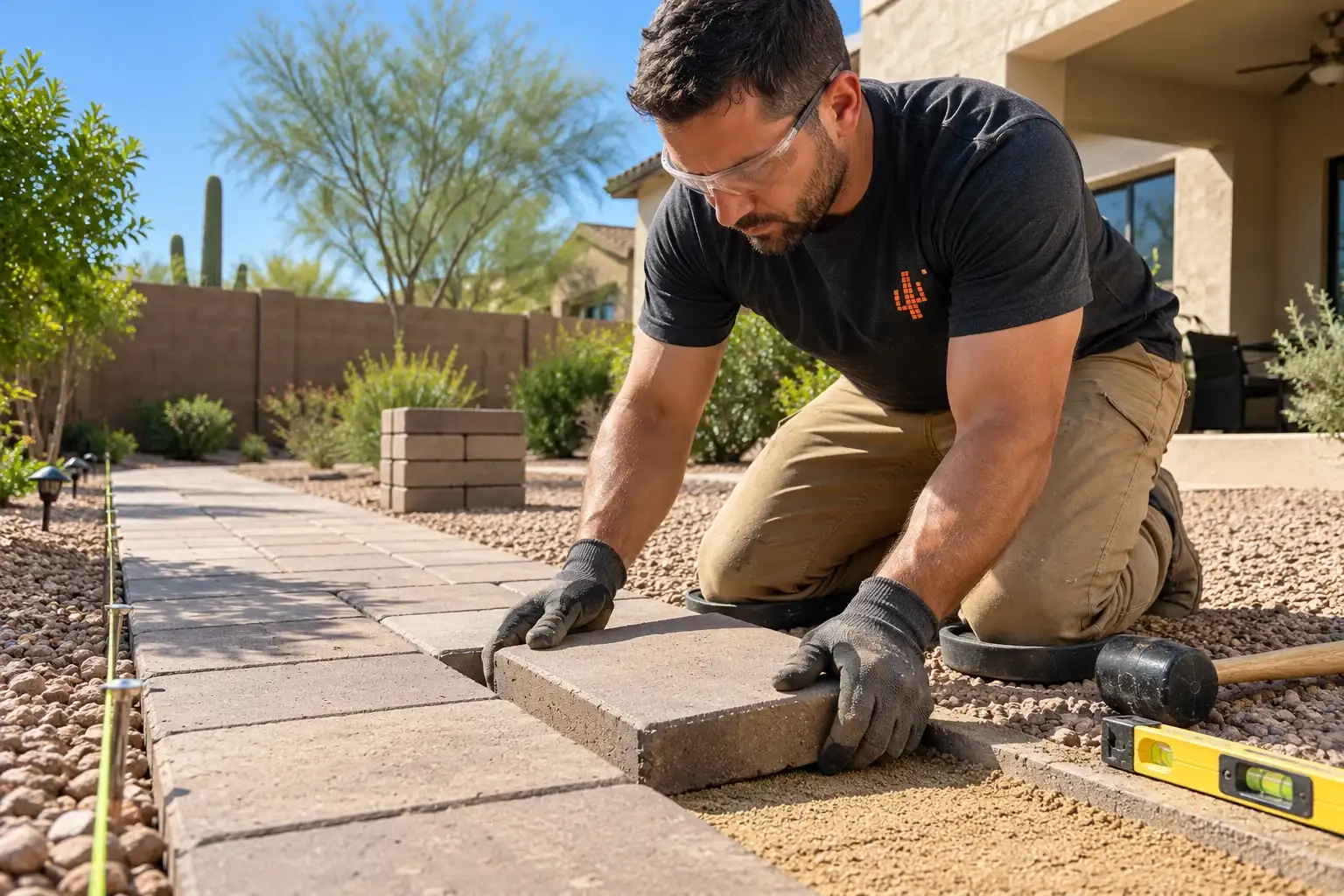
Once the layout is approved, a utility locate request goes to Arizona 811 at least 2 full working days before digging, and the utility companies mark their buried lines (APS, call 811 before you dig (opens in a new tab)). Then the surface is stripped, the excavation goes to base depth and the spoil is hauled. Base goes in lifts, wet and compacted, with the slope checked against the house. Pavers or stone are set, cut at the edges, swept with joint sand and compacted again.
The last step is a walkthrough with a hose test on the drainage. The finished surface and the place where the water leaves can be seen before the work wraps up.
04Hardscape
What is different about hardscape work in Phoenix?
2 things drive the work in Phoenix: sun and soil. Pavement in full summer sun can reach temperatures well above the air, so shade, lighter stone and the direction a patio faces get planned before the pattern.
The soil is the bigger issue. Southern Arizona soils often have a cemented layer called caliche, which can restrict water movement (UA Extension, managing caliche (opens in a new tab)). A base built the way it would be in a wetter climate can hold water against the house. Where the hard layer sits close to grade, the excavation may go deeper and be rebuilt with graded aggregate.
Summer sets the schedule as well. Mortar and sealer work best in cooler temperatures, so stone can go down early in the day and sealer work can wait for the shoulder months.
05Planning
What should I have ready before work starts?
Have the gate width and the parking plan ready first, because a pallet of pavers needs a place to land within reach of the work. If a side yard is narrow, material gets carried by hand and the labor line grows.
HOA design rules for the front yard, the pool equipment layout and the irrigation plan, if one exists, are worth having at hand. Private lines the owner already knows about, such as irrigation and lighting runs, can be marked ahead of the Arizona 811 locate.
Pick the material before the start date, not during. Stone and pavers come from different lots, so a late change can leave 2 shades side by side on the same patio. Call (747) 243-2089 or send the form once the measurements are in hand, and someone from our team will call you back.
06Hardscape
What goes wrong with pavers and walls?
Many failures start under the surface. A base that is too thin, or laid without compaction, can let pavers rock and settle after the first monsoon. A patio pitched toward the house can send water into the wall and the slab, and that can show up as a stain months later.
Walls fail when there is no footing or no drainage behind the face. Water builds in the soil, the wall leans, and the repair costs more than the footing would have.
Weeds come through joints when the joint sand washes out and nobody refills it. Efflorescence, the white haze on new pavers, is salt drawn to the surface. It washes off, but it returns if water keeps getting under the stone.
Many of these show up in the first hard rain, and many were avoidable at the base stage.
07Timeline
How long does a patio or a wall take?
A national cost guide puts a 300 square foot patio at 35 to 40 hours of labor, which can spread over several working days once material is on site. Excavation and base can be the slow part, and the stone goes down quickly after that. A wall with footings and a drainage blanket can add several days, and a long walkway can move faster than a patio of the same area because there is less cutting.
Weather moves the dates. Rain can turn a base into a mud pit, and compacting wet aggregate is best avoided. Summer heat shortens the useful hours, so work often starts earlier.
A start date and a finish date in writing help with planning, and a late delivery can push the work to another day. If the stone is a special order, the lead time sits in front of the start date rather than inside it.
08Hardscape
How do I look after pavers after installation?
Sweep the surface and refill the joints once a year, or after a heavy monsoon, with the same sand used in the original install. Full joints keep the pavers locked and keep weed seed out.
Wash with a hose and a stiff broom. A pressure washer at a high setting strips the joint sand and etches some stone, so keep the nozzle moving and the pressure low.
Sealer is optional. It deepens the color and slows staining, but it needs a fresh coat every few years and it can trap moisture if the surface was damp when it went down. On travertine, a penetrating sealer is often the safer choice.
Check the wall drainage outlets and the low corner of the patio after each rainy season.
09Good to know
Which parts of the job can be staged?
Split the job if the budget is tight. The patio is the piece that gets used every day, so start there and leave the walkway and the seat wall for a second phase.
Staging works when the layout accounts for it from the start. If phase two will add a wall along the property line, the first phase should stop the base at that line and leave the footing accessible.
The other sensible split is material. Concrete pavers on the main patio, flagstone on the path, and a plain gravel margin where the eye does not go.
The plan for later phases should be settled before excavation. Moving a finished base later costs more than building it in the right place once. A staged job also spreads the disruption, so the yard stays usable between phases.
10Costs
What is the cheaper version of a hardscape project?
The cheaper version is a smaller patio with the same base. Cutting the area by a third can save more than switching to a thin paver, because the base and the labor are a large part of the cost.
A poured concrete patio with a paver border can cost less than full pavers and still gives you the edge detail people notice. It also limits future changes, since a slab cannot be lifted and re set.
Buying stone from a yard and having it set can trim the material markup, but the buyer owns the overage and the breakage.
Keep the drainage and the base depth. Those are the 2 places where saving money costs more later. Both belong in every price, or a low price is not the same job.
11Service area
Which areas around Phoenix do you cover?
We serve Phoenix and the towns around it. That includes Ahwatukee and Laveen in the south, Arcadia and Paradise Valley in the center, and Desert Ridge, North Phoenix and Scottsdale to the north. The area also includes Tempe, Mesa, Chandler, Gilbert, Glendale, Peoria, Surprise, Goodyear, Avondale and Tolleson.
The Valley is not one soil type. Hillside lots can cut into rock and caliche, while older central neighborhoods may have mature trees and tight side yards. Both change how a base is built and how material reaches the back yard.
Call with the ZIP code and the cross streets, or send the form, and someone from our team will call you back.
12Timeline
Do pavers get too hot to walk on in summer?
Dark pavers in direct sun can get hot enough to hurt bare feet in July and August. That does not make the patio unusable, but the material and the shade plan matter.
Lighter travertine and lighter concrete pavers tend to stay cooler than charcoal or red clay units. A ramada, a shade sail or a tree on the west side can change the surface temperature more than the paver color does.
If the patio serves a pool, plan the walk from the water to the door with shade or with a lighter stone. If children use the yard, a turf or gravel play area beside the patio is easier on feet than full sun pavement.
Check a sample by hand in the afternoon sun before committing to a color.
13Hardscape
Should the patio sit flush with the house or step down?
Set the patio a step below the door threshold when the house sits higher than the yard, and keep it flush only when the slab and the soil already line up. The door still needs a threshold that sheds water away from the frame.
A step down is a common choice in Phoenix because it lets the patio pitch away from the house without fighting the weep screed. 2 risers need a rail on some plans, so that is worth checking before the layout is painted.
Where the yard slopes, a low retaining wall at the patio edge holds the grade and gives the patio a clean line. That wall needs a footing and drainage behind it, and it is cheaper to build with the patio than to add later.
145 questions
Questions people ask
Still have a question? Call (747) 243-2089 and describe the yard.
01Do I need a permit for a patio or retaining wall?
Sometimes. A flat patio at grade often needs none, but a wall over a set height, or work that changes drainage, can require one. In Phoenix, a retaining wall over 3 feet, measured from the top of the footing to the top of the wall, needs a building permit, and so does a shorter one that carries a surcharge from a house, a building, a road, a pool or a fence (City of Phoenix, required permits for fences and retaining walls (opens in a new tab)). Other towns set their own rules, so the building department for the property's address is the place to confirm before anyone digs.
02Can pavers go over an existing concrete slab?
Only if the slab is sound, clean and pitched away from the house. A cracked or settling slab will telegraph through the pavers, and the new surface adds height at the door. A thin paver can be set over a glued base when the slab passes, and the slab gets broken out when it does not.
03What is the difference between flagstone and travertine?
Flagstone is sandstone or quartzite split into irregular slabs, and it suits a path or an informal patio with wide joints. Travertine is a limestone cut to uniform thickness, and it tends to stay cooler underfoot, which is one reason pool decks use it. Travertine often costs more per square foot and is commonly sealed.
04How deep does the base need to be?
A base of 4 inches of compacted aggregate is a common minimum for a patio that only takes foot traffic, and more where the soil moves or a vehicle crosses. The base goes in thin lifts, compacted each time. Deeper base costs more now and saves a re level later.
05Will weeds come through the joints?
Some will, over time, because seed blows in and settles in the sand. A fabric under the base slows them and full joints keep most of them out. Pull what appears and top up the sand once a year rather than spraying the whole patio.