Guide 03 · 6 min read
Drip irrigation vs sprinklers in Phoenix, AZ
Drip puts water at the base of each plant, slow and deep. Sprinklers throw water across a wide area from above. In Phoenix, drip almost always wins for plants, and the failure to convert after a turf removal is how most yards die.
Good to know
The short answer
Sprinklers are for lawns. Drip is for plants. The most common Phoenix irrigation failure is sprinkler heads sized for a lawn left in place after a conversion, so shrubs get lawn water: drowned on one side, starved on the other. Drip delivers less water, slower, straight to the root zone. The right pick depends on what is planted and how the water arrives, not on which system was there first.
Water
Drip irrigation: what it actually is
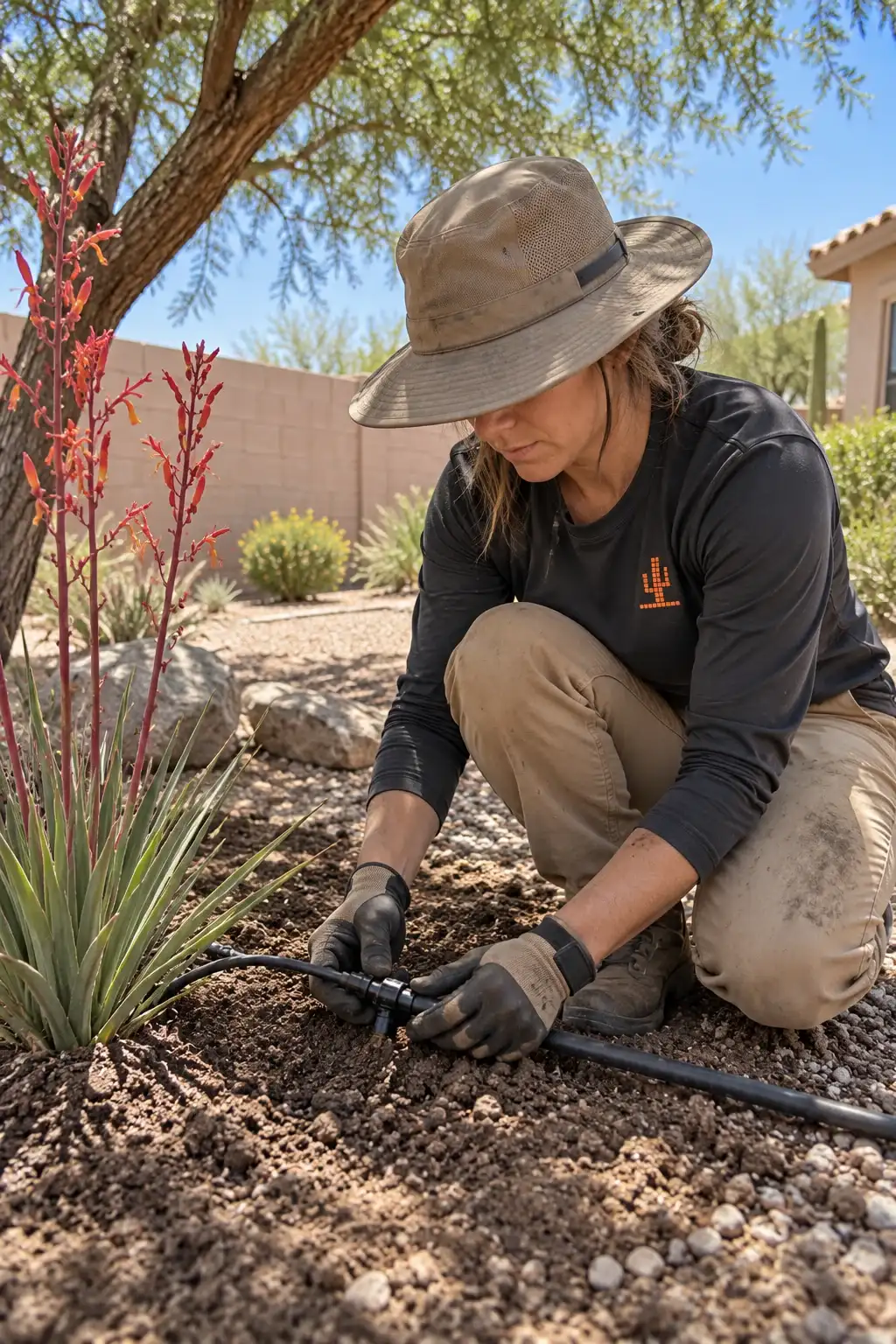
Water through a tube, one drop at a time. Drip systems run flexible tubing along the ground with emitters at the base of each plant, releasing water slowly enough that it soaks down into the root zone instead of running off. The delivery is the point: water goes where the roots are, at a rate the soil can take, and almost none of it is lost to evaporation or overspray. The trade is maintenance. Emitters are small, and Phoenix hard water is mineral rich, which means scale builds up at the emitter and one plant can go dry while its neighbor drinks. A drip system needs eyes on it a few times a year, because it fails silently, plant by plant. The other quiet failure is zone creep. A line extended over the years with extra emitters and no filter ends up watering the path as much as the plants, and the system nobody touched in years is the one that costs the most to sort out.
Water
Sprinklers: what it actually is
Water thrown into the air. Spray heads pop up and broadcast water across a wide circle, and the pattern is designed to overlap so a lawn gets even coverage. That broadcast is exactly what a lawn needs and exactly what plants do not. A shrub watered by sprinklers gets hit on one side, the water lands on the foliage, some of it evaporates in the heat before it reaches the soil, and the rest runs off the hard ground. Sprinklers also water everything in the circle, which in a Phoenix yard means the wall, the walkway, and the side of the house. Hard water scales the heads, the pattern drifts, and coverage quietly gets patchy. In Phoenix the spray also lands on hard ground, and hard ground sheds water. Clay and caliche crust over between waterings, so a share of every cycle runs off before the roots see it, which is why sprinkler minutes and plant thirst stop matching.
Water
Where drip fails here
Drip fails in Phoenix in slow motion. Hard water is the main agent: minerals scale up the emitters, flow drops, and the plant at the end of the line starves while nobody notices, because the rest of the line looks fine. Caliche is the second problem. Water drips into soil that cannot infiltrate, pools at the surface, and runs off before the roots get it, so the system looks like it is working while the root zone stays dry. On flood irrigated lots in older central Phoenix neighborhoods, drip is the supplement, not the main event. The flood arrives on its schedule and does the deep soaking, and the drip has to be zoned around it instead of fighting it. The last failure is neglect: emitters clog, tubing gets buried, and a system that fails one plant at a time never announces itself. That is why the check schedule matters more than the hardware. A few minutes a month through the hot season catches the clogged emitter before the plant pays for it.
Water
Where sprinklers fail here
Sprinklers fail in Phoenix the same way, only faster and more visibly. The heat evaporates a share of the spray before it lands, the wind takes another share, and what does land on hard, compacted ground runs off before it soaks in. The pattern problem is the one that shows up on the plants: a shrub in a lawn sprinkler's circle gets doused on one side and stays dry on the other, and the timer that runs long enough for the dry side drowns the wet side. That is the conversion problem in one sentence. A yard that switched from turf to plants but kept the lawn heads is not irrigated. It is flooded and starved on a schedule. Older central Phoenix lots add another layer. Where flood irrigation still runs, the sprinklers are usually a retrofit on top of the flood, and the two systems fight. The flood soaks the whole yard on its schedule, the sprinklers run on theirs, and the plants get double water one week and none the next. Hard water adds scale to the heads, the pattern falls apart further, and the overspray keeps watering the wall while the plants bake. Xeriscape versus gravel has the conversion mistakes in full.
Costs
What it costs and what drives the number
Drip costs more to put in than leaving the sprinklers alone, and less to run than a system that broadcasts water into the heat. The number moves with how many zones the yard needs, whether the controller gets replaced, and how much of the old system can be reused. The hidden line is hard water: a drip system in Phoenix needs a filter and regular emitter checks, and skipping them means paying to replace plants. Sprinkler numbers move with head count and with the water they waste in July, which is a monthly bill, not an install cost. Both swing with yard size and with how much existing pipe is salvageable. The controller is the quiet line item. A smart controller that adjusts with the season and skips the day after a storm pays for itself in water, and a dial timer left on its March setting is the most expensive object in the yard. Start with the landscaping guide, or the home page for everything else this site covers. If the grass question is still open, sod versus seed gets decided before the irrigation does. The landscaping cost page has the irrigation lines in context.
Good to know
What good work looks like in Phoenix
- Zoning by what the water lands on. Lawn stays on sprinklers, plants move to drip, and the two never share a timer setting.
- Planning for hard water. Filters go in at the valve, and the emitter schedule gets checked a few times a year before plants start dying one by one.
- Matching the system to the flood. On irrigated central Phoenix lots, the drip supplements the flood instead of fighting it.
- Checking the soil before the emitter gets picked. Caliche ground needs slower, longer cycles, and no amount of heads fixes ground that cannot take the water.
6 questions
Drip irrigation vs sprinklers: your questions
Still have a question? Call (747) 243-2089 and describe the yard.
Is drip irrigation better than sprinklers in Phoenix?
For plants, yes. Drip delivers water to the root zone with almost no evaporation loss, while sprinklers throw water into the heat and the wind.
Can I keep my sprinklers after removing the lawn?
You can, and that is the classic mistake. Lawn heads on shrubs put lawn water on plants, drowning one side and starving the other.
Does hard water clog drip emitters?
Yes, over time. Mineral scale builds at the emitter, flow drops, and the plant at the end of the line dries out while the rest of the system looks fine.
Do sprinklers waste water in the summer?
They lose a share to evaporation and wind, and on hard ground the rest runs off before it soaks in. Drip avoids both.
Does flood irrigation work with drip?
On irrigated central Phoenix lots, yes. The flood does the deep soaking on its schedule, and the drip is zoned to supplement between floods.
How often should a drip system be checked?
A few times a year, especially through the hot months. Drip fails silently, plant by plant, and the first sign is usually a dead shrub.